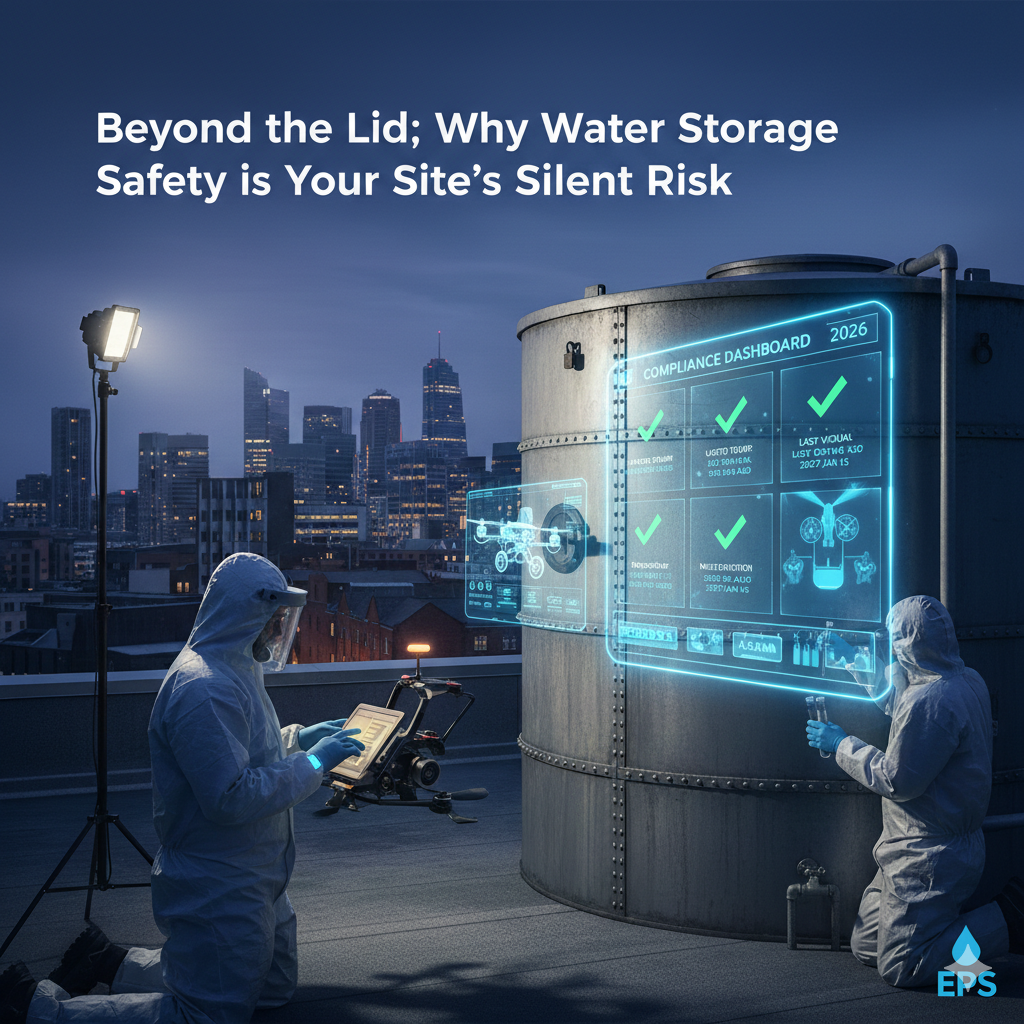
Beyond the Lid: Why Water Storage Safety is Your Site’s Silent Risk
In the high-stakes world of facility management, the water storage tank is often a case of “out of sight, out of mind.” Tucked away on rooftops or buried in plant rooms, these assets are the lifeblood of your building’s hygiene and fire safety. However, as we move through 2026, the margin for error in water safety has narrowed significantly.
Between evolving pathogens and more aggressive regulatory oversight, “checking the lid” is no longer enough. Here is why modern water storage safety requires a proactive, scientific approach.
1. The High Cost of Stagnation and Biofilm
Water is a living utility. When it sits idle in a tank, it undergoes a transformation. Stagnation leads to a drop in temperature control and a depletion of residual disinfectants (like chlorine), creating the perfect breeding ground for Legionella and other waterborne pathogens.
The real enemy, however, is biofilm. This microscopic “slime” attaches to the internal surfaces of tanks, shielding bacteria from standard chemical treatments.
- The Risk: Biofilm doesn’t just contaminate water; it accelerates microbiologically influenced corrosion (MIC), eating through steel tanks from the inside out.
- The 2026 Standard: Professional cleaning must go beyond a simple rinse. High-pressure disinfection and mechanical scrubbing are required to break the biofilm matrix.
2. Navigating the 2026 Compliance Landscape
Compliance isn’t just a box-ticking exercise; it’s your primary legal shield. In the UK and beyond, standards such as ACOP L8 and HSG274 have become more stringent regarding the frequency and documentation of inspections.
|
Task |
Frequency |
Purpose |
|
Temperature Monitoring |
Monthly |
Ensure water is stored below 20°C (cold) or above 60°C (hot). |
|
Visual Inspection |
Six-Monthly |
Check for debris, ingress, and structural integrity. |
|
Clean & Disinfection |
Annually (or per Risk Assessment) |
Remove sediment and scale that harbor bacteria. |
Failure to provide a clear “paper trail” of these actions is now being met with higher fines and, in some sectors, the suspension of operating licenses.
3. The Remote Inspection Revolution
In 2026, safety no longer always requires a confined-space entry. The rise of Remotely Operated Vehicles (ROVs) and high-definition internal cameras has revolutionized how we test and inspect tanks.
- Zero Downtime: Operators can inspect the structural integrity and sediment levels without draining thousands of liters of water.
- Enhanced Safety: By keeping engineers out of confined spaces unless necessary, you reduce the health and safety risk profile of your maintenance contract.
4. When Does a Tank Need a Full Disinfection?
While annual cleans are common practice, certain triggers necessitate an immediate, deep-clean intervention:
- After Repairs: Any time a tank is opened or structural work is performed, contaminants are introduced.
- Low Occupancy: If a building has been under-occupied (common in the hybrid-work era), stagnation risks skyrocket.
- Positive Samples: If a water test returns a high “Total Viable Count” (TVC), a chemical shock and clean is the only way to reset the system safety.
Is Your Site “Water-Safe”?
The difference between a compliant facility and a liability is often found in the maintenance schedule. Don’t wait for a failed lab test to address your storage hygiene.